
Every project is unique
Understand our industrial process
Every day, we produce 800 bespoke home design projects. Every one is special and produced to order. No products are ever mass produced or made to stock. On a day-to-day basis, that means creating a kitchen that we have never made before, a uniquely configured walk-in wardrobe, or a millimetre-perfect under-stairs unit.
Our unique capabilities can be credited to our organisation, methods and technologies, and especially the intelligence and expertise of the people forming the backbone of this complex system.
Order workflow
From the moment the order is signed in the showroom until the units are fitted in the customer’s property, the total project lead-time is eight weeks.
-
5 steps
-
8 weeks
Drawing on our employees’ manufacturing expertise
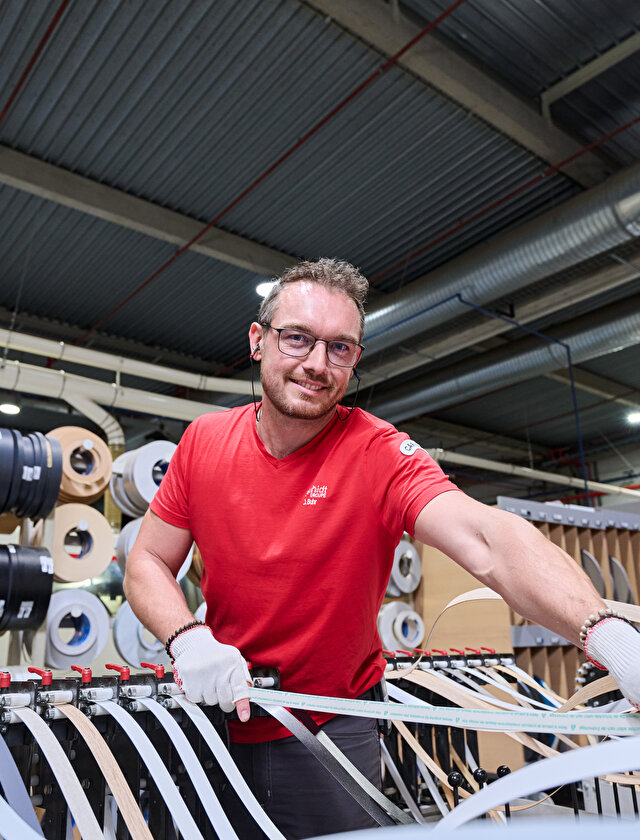
Around 800 employees work directly at our four production sites, divided equally between technical activities (maintenance, and machine and plant operations) and process activities (quality control and handling). This balance reflects a fundamental principle of our industrial model: technology does not replace people. People are the ones who operate the machinery and design the industrial processes.
The best improvements to our processes come from the day-to-day experience of our operators, who identify problems, suggest solutions and help upgrade the system.
We provide ongoing training for all our employees, whether machinery operators or engineers, directly at our production sites. Every year, around 100 apprentices join the company, and 35% are hired upon completing their training, while 25% continue their studies within the group. We also offer vocational training certificates for operators without any prior training, so that they can acquire solid technical skills and climb the ladder as machinery operators.
This learning culture is woven into our Alsatian and German DNA, where the tradition of transferring knowledge has long been a force for shaping industry. Behind this practice lies the firm belief that intelligence comes from the shop floor.


Guaranteeing product quality
This combination of human and industrial expertise only makes sense if it results in products that deliver on their promises over time. That explains why our quality system underpins the entire process, from selecting raw materials through to fitting our products at the customer’s property. This commitment is reflected at every stage and upheld by every employee.

Using smart technologies
We have been using algorithms for over 15 years…
…long before the term “artificial intelligence” became a household name. Today, we are incorporating technology and AI into all our processes, from bespoke project planning by our designers to predictive maintenance.
Data management and data reliability are one of our most strategically important areas of activity.
Every part has a unique barcode. Schmidt Groupe does not believe in batches or bundles. Every panel, every drawer and every front is individually tracked from start to finish.
The technical configurator (a proprietary algorithm) breaks down each kitchen into material requirements, machining programmes and production processes.
Over 100 in-house IT experts design and organise all the company’s smart technologies.

Innovation as a key differentiator
Faced with growing pressure from the sector’s major players in the 1960s, we had two choices: either enter into a price war or pursue a strategy that would enable our company to stand out from the competition. We went for the second option.
So how did we achieve that? By consistently offering what was not available from our competitors.
Twenty years ago, when customers only had a choice between oak or white finishes in the market, we began offering 10 colours. Today, we offer 50, with the option of a bespoke finish in any colour.
This differentiation strategy pushes our Group to constantly stay ahead of the innovation curve for our products, our machinery and our sales tools.

We challenge our suppliers to develop the machines or materials that we need, but which are not yet available on the market.
Our recent innovations are aimed at configuring our customers’ projects using artificial intelligence:
- Styl’IA is an advanced configurator developed in collaboration with Strasbourg-based company Hapticmedia. The solution allows customers to visualise their project, fine-tune their plans, and see updated prices in real time.
- Dreamview is an AI-powered rendering tool that transforms a technical project into a realistic and immersive visual in mere seconds. The visual is automatically enhanced to help customers picture their design more clearly and speed up their final decision.
At Schmidt Groupe, our innovation strategy is not restricted to our manufacturing processes. It can be found everywhere, whether in our sales, products, services or materials.
Innovating for sustainable living

Improving performance through automation
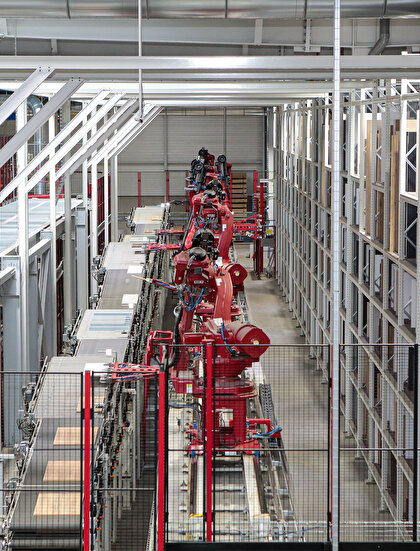
Some 200 robots have been rolled out across our four production sites.
Schmidt Groupe began automating its plants in 2008 before accelerating the pace of change with every plant upgrade or new site.
Our robots may have articulated arms and automated gripping systems, but they are no replacement for people. Instead, they prevent them from having to perform the most physically demanding tasks. Carrying heavy loads, handling bulky parts and performing repetitive movements are just some of the areas where robots can bring a direct benefit in terms of improving occupational health and safety.
Employees are always involved, so that they can operate, control and improve the machine’s performance.
We are also taking measures to make our workstations more ergonomic, such as testing exoskeletons to reduce muscular strain, adjusting heights and distances, and reorganising workflows to minimise unnecessary movement.
These investments are part of our long-term strategy to provide our employees with good working conditions throughout their careers.


Promoting continual improvement
Continual improvement is a focal part of our organisational culture.
We have developed the ability to take a critical look at our own performance, so that every day we can steer the company down a path that will ensure its long-term prospects. This principle is based on a two-pronged approach: daily improvements suggested by the operational teams and continually put into practice, and innovative investments to transform our production capabilities.
Discover our continual improvement culture
