
Style & Design
Schmidt Groupe's short design stories
Design is shaped and influenced by an era’s prevailing trends, a specific need, or evolving lifestyles. Every item designed since 1946 reflects society’s ever-changing aspirations and constraints, and people’s longing for a better life.
These “short design stories” provide a timeline of the various objects that have graced French and then European homes over the years, setting trends in the process and leaving an indelible mark on design styles. They tell the story of who we have become with each passing generation.
1946
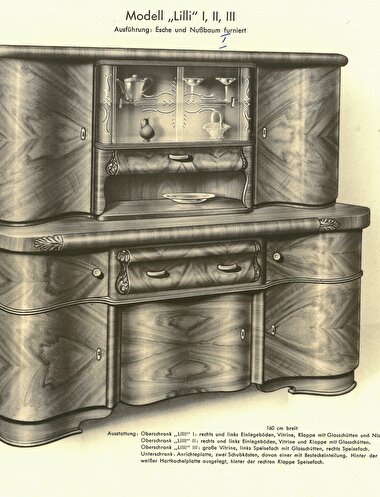
Lilli
Lilli was the first in a long line of sideboards.
Lilli marked the start of a series of units featuring female names, including Heidi, Carmen, Herta, Marta, Sonja, Senta, Astrid and Brigitte. These sideboards were initially made from oak and later from laminate. Both practical and modern, they were a common sight in French homes until the 1980s.
Before branching into the furniture sector, Schmidt used to build houses in the Saarland.
1959
Prestige 150
Schmidt’s teams created the Prestige 150, which soon became an iconic fixture in French kitchens. Its light bar, built-in mirror and thermometer were just some of the details that left their mark on an entire generation of kitchens. The Prestige 150 embodied the functional design of the post-war economic boom and the dream nurtured by French households for a modern equipped kitchen.

1965
Formica
Yellow, blue, green… sideboards began embracing the Formica revolution, as this modern and practical laminate soon made inroads into every kitchen. Both easy to clean and hard-wearing, Formica was a must-have for French households. From suburban houses to apartments, everyone wanted a Formica sideboard, whether freestanding or wall-mounted. The era of standardised units had arrived.

1975
Fully equipped kitchens
Sideboards were confined to the history books as consumers set their heart on owning a fitted kitchen. Base and wall units could be assembled to form a complete kitchen, often with an L-shaped layout.
Solid oak dominated the market at first, before laminate became the firm favourite. This development heralded the beginning of the bespoke kitchen trend. Kitchens were now designed as true home interior projects, rather than as a simple selection of units.
To coincide with this innovation in the kitchen market, Schmidt Groupe released its first catalogue featuring eight full-colour pages.

1990
Open plan kitchens
Kitchens opened onto the living room. With households feeling the pinch as the cost of living and the price per square metre began spiralling upwards, open plan kitchens provided a solution for making best use of the available space in both houses and apartments.
This open space became the heart of the home, an inviting place where people could cook, socialise and entertain.
Two distinct styles emerged in the 1990s, namely contemporary lacquered and glossy designs on the one hand, and Provençal-style designs with kitchen mouldings on the other.

1998
Flat-pack kitchens
Schmidt broke into a new market by offering flat-pack kitchens for the mass-retail sector and for Cuisinellà’s entry-level range. EMK, the Group’s European subsidiary for flat-pack units, offered 57 modules that could be delivered within a week to homeware retailers. This innovative range was clearly distinct from the Group’s line of factory-assembled kitchen units, with the aim of targeting a wider base of customers on a tighter budget. The venture came to an end in 2015 when Schmidt decided to refocus its attention on its core business of fitted kitchens and its exclusive showroom networks.

2001
Colour
For decades, kitchen carcases had been produced in white. Only the fronts could be used to add a touch of colour to the kitchen. Schmidt broke with convention by offering carcases in a variety of colours, including grey, anthracite, mole and wood. Now customers could play around with an endless combination of carcase fronts and interiors. The mere act of opening a cabinet could be turned into an aesthetic experience. This innovation heralded a milestone in personalised home interiors, since bespoke designs could now be introduced inside the units, rather than restricted to their doors and fronts.

2005
The first interior solutions
Schmidt extended its expertise in kitchens to the entire home. With the first walk-in wardrobes, storage units and cabinets, the Group began offering bespoke solutions for every room of the home to cater for every need. This decision to diversify the company’s core business marked a decisive turning point in Schmidt’s strategy. The company wanted to break beyond the confines of the kitchen and achieve its firm ambition of delivering solutions for the entire home with the same commitment to quality and personalised designs.

2008
In&Out
This kitchen created a connection between the interior and the exterior as home interiors began opening onto the garden. With its airy legs and metal frames, In&Out combined strong aesthetics with a stylish ergonomic design. A year later, this range earned Schmidt the Janus de l’Industrie, an official French design award that was created back in 1953, as a testament to Schmidt’s ability to continually break new ground with increasingly modern and stylish designs.

2008
Temptations collection
A contemporary, factory-assembled kitchen with a price tag starting at €4,000. With the Temptations collection, Cuisinella proved that simple, on-trend designs were not restricted to consumers with large budgets. With 180 units, high-performance worktops and stylish finishes, Cuisinella showed that people on a budget could also treat themselves to a designer kitchen without compromising on quality.

2018
Cuisinella’s innovative solutions for everyday needs
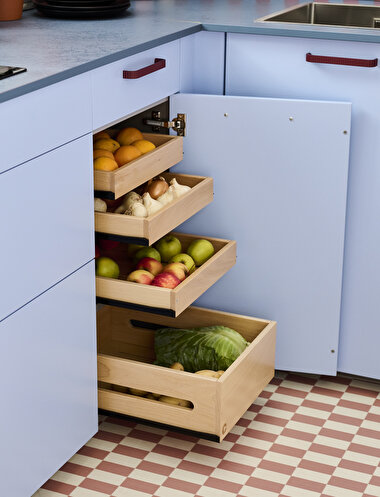
Extend the worktop when needed, store fruit and vegetables other than in the fridge, and save space with pull-out trays in the most compact apartments… Cuisinella launched a number of innovative features that were just as functional as they were unexpected in an effort to deliver a solution to real everyday needs. Cuisinella showed that style and practicality could be combined to produce a flawless design after closely observing how people used their home interiors.
2022
Digital printing
This was a first in the French kitchen market. The Group launched a range of digitally printed fronts and backsplashes, so that its customers could print any design on their units and add a daring touch to a kitchen, bathroom or walk-in closet.
To coincide with the launch, the Group collaborated with Christian Lacroix, who brought his touch of high-end fashion to the Schmidt brand. Since then, we have regularly been working with artists to give our products even more personality.

2024
Spoon & Room and the perfect island
Spoon & Room embodied Schmidt’s response to the health crisis in the form of versatile, discreet units ideally tailored to small spaces. Available in two sizes, this perfect island fits seamlessly into any room. Whether used as a kitchen worktop, a home office desk, or a dining area, this unit adapts to modern lifestyles and the constraints facing today’s urban apartments. The brand will be discontinued in 2026, but the spirit of innovation lives on.

2025
The central island
Kitchen islands finally entered the mainstream after initially being reserved for high-end kitchens. Whether a mobile island on wheels from Cuisinella or a showstopper from Schmidt, islands offer increasing versatility to meet a wide range of uses, whether as a kitchen worktop, a social space, a homeworking area or a kids’ desk. This storage solution is a fully integrated part of the kitchen.

2026
Millimetre-perfect sloping solutions
Whether beneath the eaves or under the stairs, Schmidt and Cuisinella are tackling those spaces where customers can gain valuable extra storage space with bespoke solutions boasting millimetre precision, for transforming every architectural constraint into a habitable, functional, and stylish space.
